Balayage vs. Highlights: What Actually Makes Them Different
Both lighten the hair. Only one is painted by hand, and the difference shows most in how it grows out.
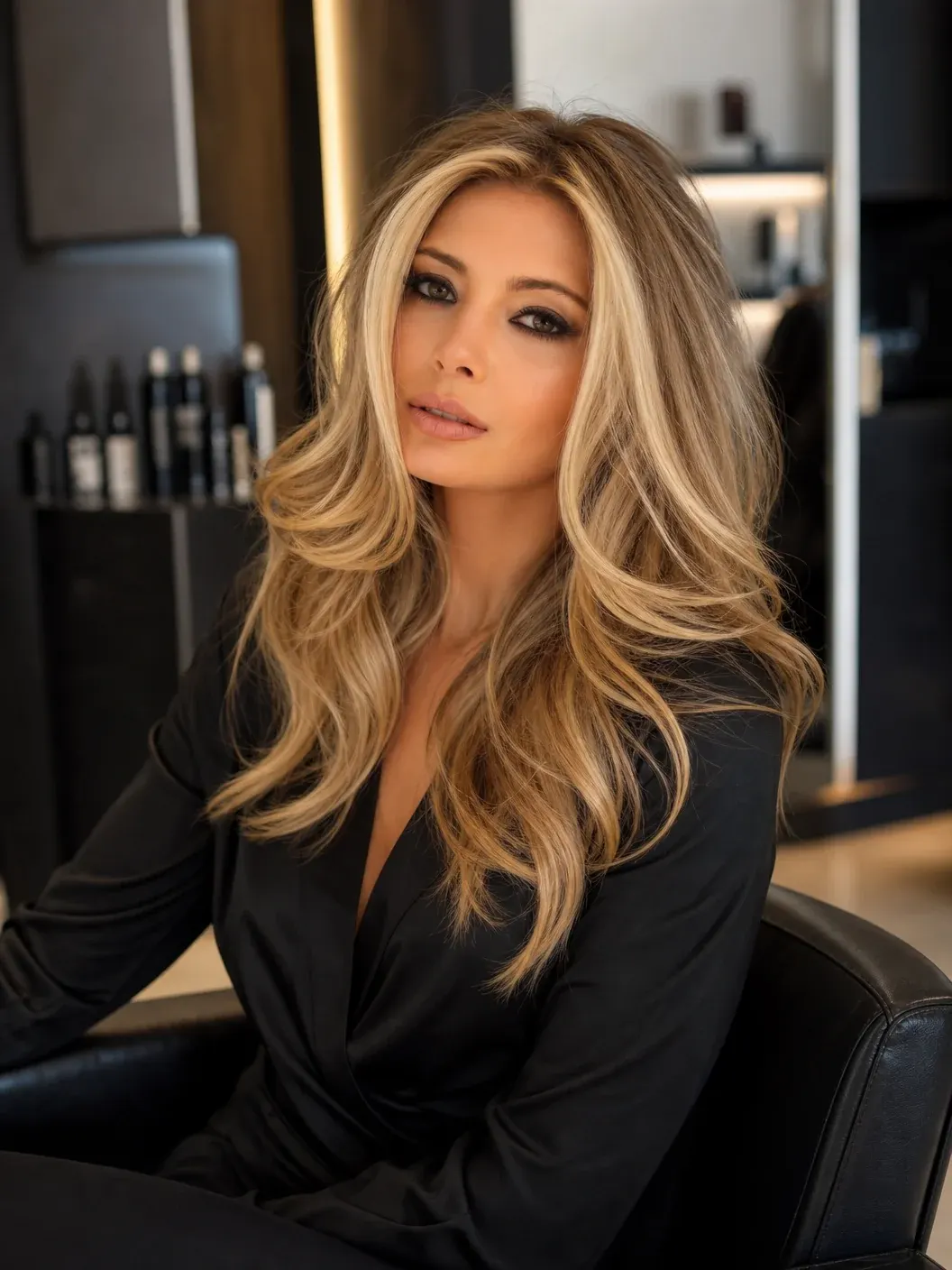
The short answer: highlights are woven into foils, which lift evenly from the root and leave a line as they grow out. Balayage is painted freehand on the surface of the hair, so the light fades in softly with no line at all. The difference you live with is the grow-out.
Guests ask for balayage and highlights as though they were two words for the same service. They are not. Both lighten the hair, both add dimension, and both can be beautiful. What separates them is method, and the method is what you live with for the next six months. If you already know hand-painted color is what you want, our French Balayage page covers how we place it, in daylight, at the studio.
Highlights are placed. Balayage is painted.
Traditional highlights are woven into sections and wrapped in foil. The foil holds heat and forces lift, which is why the result is even, predictable, and uniform from root to tip. Every strand in that foil lightens by the same amount, starting at the same place, usually right at the root.
French European balayage is painted freehand, strand by strand, with no foil at all. Your colorist decides where the light lands, how heavy it falls, and where it fades to nothing. Nothing forces the lift. The color is placed the way light would actually fall on your hair.
That difference sounds technical. It is not. It is the whole thing.
The grow-out is the real difference
A foiled highlight begins at a fixed point on the strand. As your hair grows, that point travels away from your scalp, and the line it leaves behind travels with it. Six weeks later there is a visible band where the highlight starts. That band is why highlights are maintained on a calendar.
Balayage has no starting line. The paint is feathered at the top so there is no edge to grow out, only a soft gradient that keeps drifting downward. There is nothing to give it away at six weeks, or at twelve.
This is what we mean when we say balayage is low maintenance. It is not that it needs less care. It is that it has no line to correct.
Who each one suits
Highlights still do things balayage cannot. If you want uniform brightness through the whole head, or you are lifting a dark base several levels, foils remain the honest answer. They are precise, and precision is sometimes exactly what a head of hair needs.
Balayage suits you if you want your color to look like it happened to you rather than to your hair. It suits you if you would rather come in three times a year than eight. It suits you if the words you keep using in the consultation are natural, soft, or lived-in.
Most people who ask us for highlights are describing balayage.
What "less is more" means in practice
Our guiding philosophy is that less is more, and it is not a slogan about restraint for its own sake. Every extra pass of lightener is a withdrawal from the health of the hair. Painting by hand means we can take exactly what a strand can afford and no more.
Because we do not use chemical smoothing treatments such as keratin, the condition you leave with is the condition the color has to live in. We use and recommend Milbon hair care, the Repair line in particular, to strengthen and protect the hair after a color service.
Which lasts longer, balayage or highlights?
Balayage lasts longer between appointments, though neither technique fades faster than the other. Most balayage guests return every three to six months. Foiled highlights are usually refreshed every six to eight weeks. The pigment behaves much the same in both; what differs is how long the grow-out stays invisible. A foil has a starting line that becomes visible as soon as the hair moves away from the root. A painted highlight has no line to become visible, so nothing forces you back on a schedule.
Is balayage more damaging than highlights?
Balayage is usually the gentler of the two, but the technique matters less than how much lift is asked for. Damage comes from the amount of lightener a strand takes and how long it stays on, not from whether a foil was involved. Foils tend to be harsher in practice because the foil traps heat and drives an even, aggressive lift from the root. Painting by hand lets a colorist take exactly what a section can afford and stop there, and it keeps lightener off the root, where hair is newest and most fragile. A heavy-handed balayage can still overreach. A conservative foil can be perfectly healthy.
Can you get balayage and highlights together?
Yes, and on some hair it is the right answer. Foils can build brightness through the interior or lift a stubborn dark base, while hand-painted pieces sit on the surface to soften the result and remove the grow-out line. Used together the foil does the heavy work and the balayage does the blending. The risk is doing both simply because you cannot decide, which lightens more hair than the look actually needs. That call belongs in the consultation, in daylight, with your hair in front of us.
Balayage vs highlights on dark hair
On dark hair the choice is sharper, because the contrast is less forgiving. Foils lift dark hair more reliably, which is why several levels of lift usually starts with them. Balayage on a deep base is about placement rather than brightness: fewer, better-placed pieces that read as movement instead of stripes. Painted too light too fast, dark hair goes brassy, since it passes through orange on the way to blonde. This is the case where the honest answer is often a slower plan across more than one appointment, and we would rather say that at the consultation than discover it mid-service.
Before you book
Come with completely clean hair and no product, so we can read your true texture and condition in daylight. Bring a photo of what you have in mind, and if you can, a few images of shades you have loved before. We keep a short guide on how to arrive at your consultation so the half hour before your appointment works in your favor.
And book your cut before your color. The cut is the foundation; the color is the makeup that enhances its shape and movement. Painting light onto a shape we have not decided on yet is guesswork, and guesswork is the one thing hand-painted color cannot survive. We explain why the cut comes first in its own post.
When you are ready, book a consultation at 130 E 65th Street on the Upper East Side, and we will read your hair in daylight before recommending either technique.